How Professional Lice Removal Actually Works: A Transparent Look Behind the Process
If you've never used a professional lice removal service, the experience is a bit of a black box. You call. Someone arrives. They do something for an hour or two. The lice are gone. You pay. They leave.
Most parents we work with admit, after their first visit, that they weren't sure what they were paying for until they saw it. Was this just a fancy version of what they could do at home with a $10 comb? Was the price reasonable for what was actually delivered? What made one service better than another?
Those are fair questions, and the lice removal industry doesn't always answer them clearly. This guide is an attempt to do exactly that. A transparent, step-by-step look at how professional lice removal actually works, what the training and equipment involve, why each step exists, and how to verify whether a service is doing it well. Nothing is being hidden, including the honest reasons professional removal works and the parts that aren't magic.
Considering a professional appointment? Larger Than Lice provides 24/7 in-home lice removal across NYC with full transparency about every step. Call (631) 810-3938 or book online.

What Professional Lice Removal Actually Is (Honestly)
Let's start with what it's not. Professional lice removal is not a magic technology or a secret formula. It is not a chemical that drugstore shampoos don't have. It is not a treatment that's medically distinct from DIY methods in some categorical way.
Professional lice removal is the same fundamental approach a parent could theoretically do at home (combing every nit and louse out of the hair with a fine-toothed comb), executed by a specialist with:
Better tools than parents have
Better training than parents have
Better lighting than home environments
More time than parents can typically dedicate
More patience than tired parents at 9 PM
Pattern recognition from doing thousands of cases
That's it. There's no secret. The reason it works better and faster than DIY isn't a special chemical or a proprietary device. It's the combination of these six factors applied with consistency across the full head.
We say this up front because some lice services market their work as if it's a hidden science. Honest services don't need to. What they do is verifiable, observable, and explainable. The skill is real. The mystery isn't.
The Five Steps of a Professional Treatment
Every professional lice removal appointment follows roughly the same structure. The names of the steps vary by service, but the actual work is consistent.
Step 1: Screening (5 to 15 Minutes)
The first thing a specialist does is verify what's actually going on. About half of suspected lice cases turn out to be something else: dandruff, hair casts, hair product residue, scalp buildup, or in rare cases, scabies or other conditions. We covered the false-positive scenarios in signs your child has lice before the school calls you.
The screening involves:
Sectioning the hair under bright light
Examining the scalp area behind the ears, at the nape of the neck, and along the part line
Looking for live lice (tan, fast-moving, sesame-seed sized) and nits (yellowish-white, glued to hair strands within a quarter inch of the scalp)
Assessing the severity of the case (a few nits vs. an established infestation)
Checking other family members if requested
If no lice are found, the specialist will say so. A trustworthy service charges for the screening visit but does not invent a case to treat. If a specialist confirms a treatment is unnecessary, that's a sign of integrity, not a missed sale.
Step 2: Treatment Application (10 to 15 Minutes)
If lice are confirmed, the specialist applies a treatment solution to the hair and scalp. The solution varies by service. Most reputable services use pesticide-free, non-toxic products. The role of the solution is twofold:
Loosen the nit glue. Lice eggs are cemented to hair strands with a protein-based glue. The treatment solution dissolves or weakens this glue so the nits can be combed out rather than scraped off by hand.
Slow down or kill live lice. Live lice become sluggish or immobilized, making them easier to capture during combing.
The solution dwells on the hair for 5 to 15 minutes depending on the specific product. During this time, the specialist sets up the workspace, prepares the equipment, and gets the child comfortable.
Some services use heated air devices (FDA-cleared "AirAllé" or similar) instead of a topical solution. These devices use directed hot air to dehydrate lice and eggs. We'll address heat-based treatments more below, but the honest reality is that even heat-based clinics still follow up with the same manual combing that defines manual-removal services.
Step 3: Manual Removal (45 to 90 Minutes)
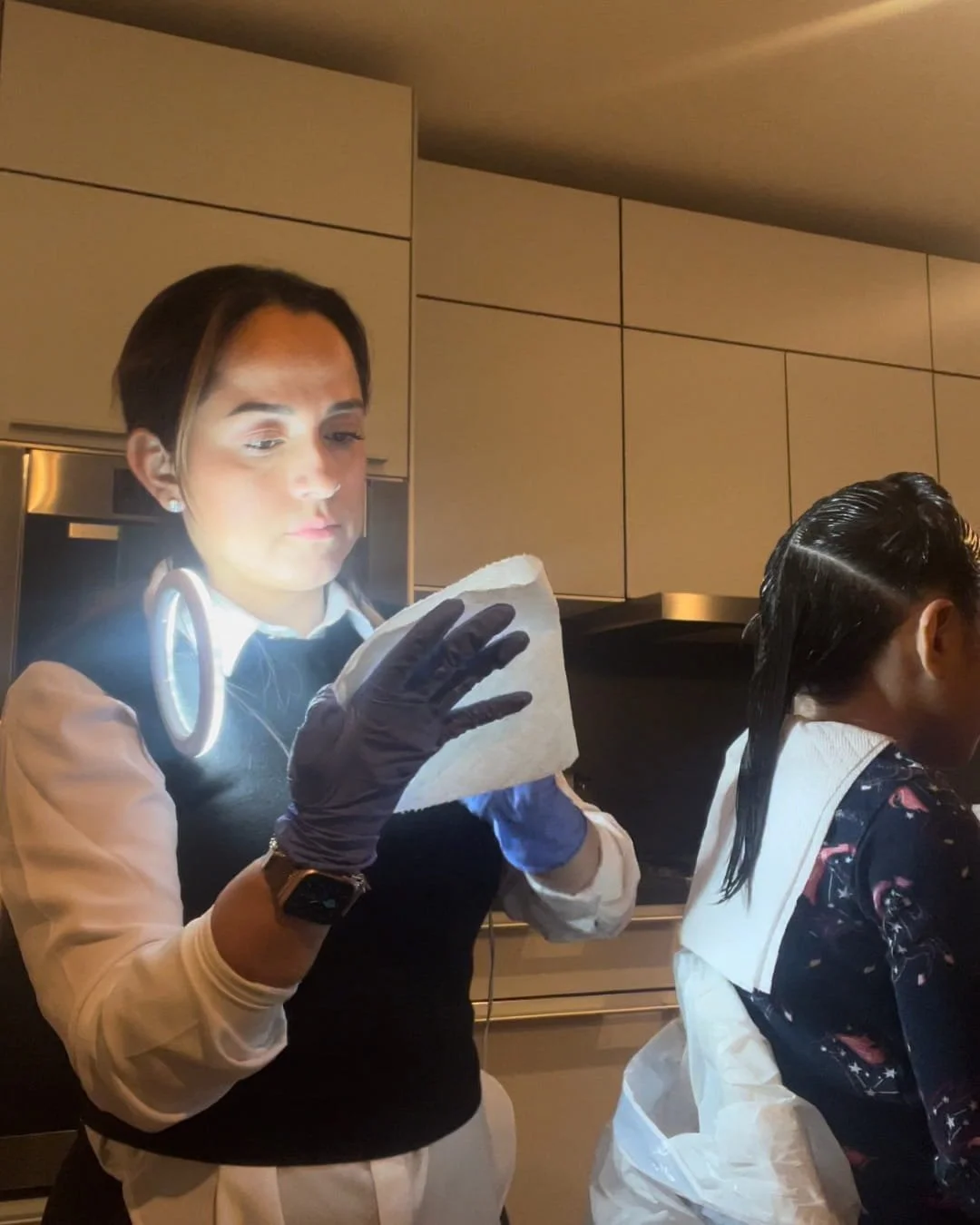
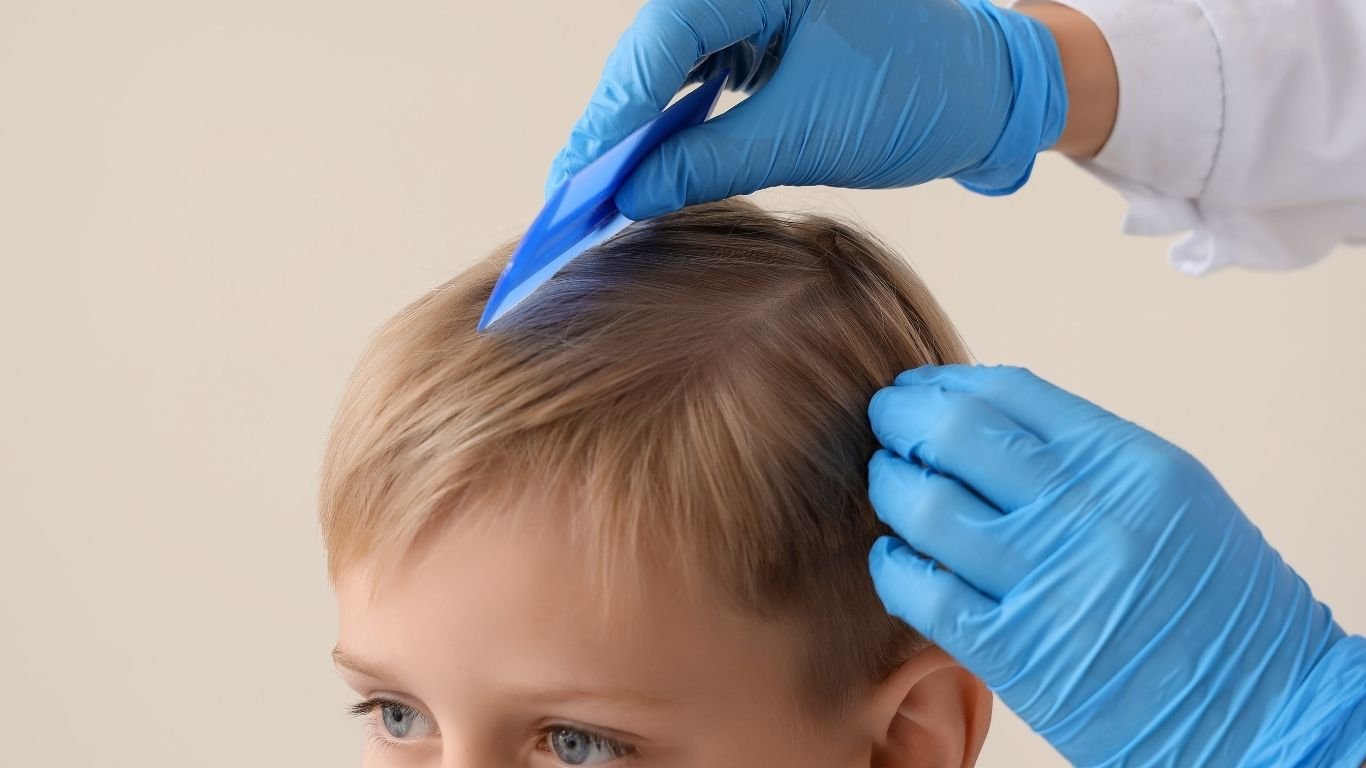
This is the actual work. The specialist sections the hair into small parts (typically 30 to 50 sections for an average head of hair) and combs each section systematically:
Drawing a professional metal lice comb from scalp to tip
Wiping the comb onto a white paper towel after each pass
Inspecting the paper towel for nits and live lice
Re-combing each section 3 to 5 times to catch what was missed
Visually re-checking each section under magnification
The combing technique matters. Specialists draw the comb close enough to the scalp that the teeth catch nits glued near the root. They angle the comb consistently. They don't skip sections, even on smaller areas like the back of the neck or behind the ears where lice cluster.
For an average elementary school child with shoulder-length hair, this step takes 45 to 90 minutes. For very long, thick, or curly hair, it can take 2 hours or more. The point of professional removal is to take as long as the case requires, not to fit a fixed time slot.
Step 4: Final Inspection (10 to 15 Minutes)
After the main combing pass, the specialist does a full-head visual inspection under bright light or magnification. They look for:
Any remaining nits glued to hair strands
Any live lice that hid during the main combing
Any sections that need additional re-combing
If anything is found, that section is re-combed and re-inspected. A trustworthy professional will only declare the treatment complete when they're confident no nits remain.
Step 5: Clearance and Aftercare (5 to 10 Minutes)
Once the head is clear, the specialist:
Writes or prints a clearance letter for school re-entry
Explains aftercare steps for the next 14 days
Provides instructions on what to wash at home (much less than parents typically assume; see de-lousing the house for details)
Explains the 4-week lice-free guarantee
Answers any remaining questions
Total appointment time: typically 1 to 2 hours per person. Some cases run shorter (mild, short hair, cooperative kid). Some run longer (heavy infestation, very long or curly hair, multiple family members).
Every step above happens in your home, not a clinic. See how our in-home lice removal works across New York, including same-day availability and what the guarantee covers.

What Training a Professional Specialist Actually Has
This is the part most lice services don't talk about openly. There is no national certification body for lice removal specialists, no required medical degree, and no government licensing requirement in most states (including New York). So how do you know a specialist is qualified?
Here's what reputable services actually require of their specialists.
Internal Training Programs
Most established lice removal services run their own training programs. At Larger Than Lice, new specialists go through:
40 to 80 hours of supervised training
Multiple cases observed and assisted before solo work
Pattern recognition training (lice vs. dandruff vs. scalp conditions)
Combing technique standardization
Customer service and discretion protocols
Aftercare and clearance documentation training
This is comparable in depth to many hairdressing certifications. It's not medical school, but it's substantial.
Pattern Recognition From Experience
The bigger factor is volume. A specialist who has worked 500 cases sees patterns that a parent doing their first case will miss entirely. They know what nymphs at different life stages look like. They know where lice hide on different hair types. They can spot residual nits in seconds that an untrained eye would miss after 10 minutes of looking.
This experience-based skill can't be replicated by reading a guide. It comes from working through hundreds of real cases under supervision and feedback.
Continuing Education
Reputable services maintain ongoing training. Lice biology, new product research, school policy updates, customer service protocols. Specialists who started 5 years ago and never updated would be working with outdated information today.
What to Ask
If you want to verify a service's training standards, the following questions are fair:
How many hours of training do new specialists complete?
How long has the typical specialist been with your company?
What's the supervision protocol for newer specialists?
How are quality issues addressed if a case isn't fully cleared on the first visit?
A service that can answer these clearly is one that has thought through quality. A service that gets defensive or vague about training is one to be cautious about.
The Equipment Difference
This is where the gap between professional and DIY is most measurable.
Professional Metal Lice Combs
A professional lice comb has stainless steel teeth, typically spaced 0.2 millimeters apart or less. The teeth are micro-grooved to grip and pull nits off hair strands. The comb is designed to slide between hair shafts smoothly without bending.
A drugstore plastic comb (the kind included with Nix or RID) has wider tooth spacing, smoother teeth, and significantly more flex. The teeth bend, miss nits, and let live lice escape.
The cost difference is meaningful: professional combs run $25 to $60 each. Drugstore combs are essentially free with the shampoo. The difference in catch rate per pass is something like 10x to 20x in favor of professional combs.
The comb we use and sell is the Nit Terminator Comb. If you buy one thing after reading this guide, make it that.
Magnifying Lighting
Professional specialists work with magnifying lamps or other bright direct lighting, often LED. This reveals nits invisible under standard household lighting. A parent doing DIY combing under a kitchen overhead light is genuinely seeing less than half of what's on the head.
Pesticide-Free Treatment Solutions
The specific products used by lice removal services vary. Most reputable services use:
Plant-based or enzyme-based solutions that loosen nit glue
Non-toxic, pesticide-free formulations safe for kids, pregnant women, and chemical-sensitive family members
Products tested for effectiveness on resistant lice strains
You can ask any service what products they use and verify the ingredients. Services that hide ingredient information are services to be cautious about.
Heated Air Devices (Optional)
Some clinics, notably Lice Clinics of America, use FDA-cleared heated air devices like AirAllé. These devices direct controlled hot air at the scalp to dehydrate lice and eggs. The devices are real and work as advertised in killing lice and a high percentage of eggs.
However, the honest reality is that even clinics using heated air devices still follow up with 30 to 60 minutes of manual combing to remove the now-dead lice and remaining nits. The combing is what completes the treatment in either approach. The device is a faster knockdown of live lice, not a replacement for manual nit removal.
For families considering heated air vs. manual-only services, the practical difference is often small. Both finish in roughly the same total time. Both rely on combing for the actual nit removal. Heated air can add $100 to $200 to the price, primarily for the device cost amortized into your visit.
Why Each Step Exists (The Science)
Here's the scientific reasoning behind each part of the professional protocol.
Why Pre-Combing Treatment Helps
Lice eggs are glued to hair strands with a protein-based cement that's nearly insoluble in water. A regular comb passes over nits and slides off them, even with a tight tooth spacing. The treatment solutions break down or soften this protein, making nits removable by combing rather than by manual scraping. This is the actual reason the dwell time matters; it's not just symbolic.
Why Section-by-Section Combing Matters
Hair has roughly 90,000 to 150,000 strands on an average head. Lice and nits can be anywhere among them. Section-by-section combing ensures every strand is covered. A "general" comb-through covers maybe 30 to 50% of strands. Methodical sectioning covers nearly 100%.
Why Repetition Catches What's Missed
The first comb pass catches most lice and easy nits. The second pass catches what was tangled or hidden. The third pass catches what was missed because hair shifted during the first two passes. Each repetition adds catch rate, and most professional protocols include 3 to 5 passes per section.
Why Magnification Matters
A newly-laid nit can be as small as 0.3 millimeters. Under normal household lighting, it's barely visible. Under magnification with bright direct light, it's clearly visible. The reason DIY combers miss nits isn't carelessness; it's that they literally cannot see what they need to remove.
Why the 14-Day Follow-Up Exists
Lice eggs take 6 to 9 days to hatch. New nymphs take 9 to 12 days to mature into reproductive adults. If a single egg was missed during the initial treatment, it hatches into a louse that starts laying its own eggs around day 14 to 21. The 14-day check (built into NYC school policy and into most professional service guarantees) catches this scenario before a new infestation can spread.
How to Verify a Professional Service Is Doing It Right
Here's a checklist you can use to evaluate whether your appointment is being handled professionally.
Before the Appointment
Did the booking call reach a real specialist, not a chatbot or call center?
Were prices given as flat rates rather than vague ranges?
Was the appointment scheduled for at least 1 to 1.5 hours per person?
Were aftercare and guarantee terms explained upfront?
During the Appointment
Did the specialist do a screening before applying treatment?
Was the treatment solution explained, including what's in it?
Did the specialist section the hair into small parts (not just big chunks)?
Was the combing methodical, with each section combed multiple times?
Was the comb wiped onto a paper towel after each pass for inspection?
Was bright direct lighting used throughout?
Was a final full-head inspection done before declaring the case clear?
After the Appointment
Did you receive a printed or emailed clearance letter?
Were aftercare instructions explicit and clear?
Were the guarantee terms in writing?
Was follow-up contact information provided?
A service that hits all of these is a service operating at a professional standard. A service that skips multiple items on this list is one to question, even if their marketing claims look strong.
What Honest Specialists Will Tell You
Trust-building also means knowing what an honest service will admit, even though it might not help them close a sale.
"We Can't Guarantee Lice Won't Come Back If You Get Re-Exposed"
A professional treatment clears the current case completely. It does not prevent your child from getting lice again if they're exposed to a new case at school or a sleepover next week. Reputable services back their work with a guarantee for re-treatment if the same case reappears within 30 days (because of a missed egg), but they don't claim to prevent new infestations. We covered this in how lice spread in classrooms.
"Your Cleaning Doesn't Need to Be Extreme"
A specialist who tells you to wash everything in your apartment, throw out toys, vacuum every couch, and bag up clothing for two weeks is either misinformed or upselling. The actual cleanup is much shorter: pillowcases, sheets, hats, and brushes from the last 48 hours. That's it. Most lice die within 24 to 48 hours off a human scalp. Read de-lousing the house for the honest breakdown.
"Sometimes a Case Looks Mild But Isn't"
If your specialist starts the treatment and discovers the case is more advanced than the initial screening suggested, they may need to extend the appointment. A trustworthy specialist tells you this upfront rather than rushing the work to fit the original timeframe.
"OTC Treatments Sometimes Make Our Work Harder"
If you used Nix or RID before the professional visit, residue can sometimes interfere with the loosening of nit glue. A specialist who tells you this isn't blaming you; they're being honest about why the appointment may take longer. We covered the comparison in drugstore lice treatments vs professional removal: what works faster.
"Your Child May Still Be Itchy for Days"
Even after a complete treatment, the scalp can remain itchy for 7 to 14 days as the allergic reaction to past bites subsides. New itching is not necessarily new lice. A reputable specialist explains this so you're not panicking on day 4.
Common Misconceptions Professional Specialists Hear All the Time
A few things parents often believe that aren't quite right.
"Lice Mean My Kid's School or Friend Has Poor Hygiene"
Lice prefer clean hair. They have no preference for hygiene level, income bracket, or school type. The CDC, AAP, and every lice professional agree on this. The kids who get lice are usually the kids who hug their friends, sit close together, and share their hair clips. We covered this in why lice outbreaks are common in NYC private schools.
"I Can Spot Lice Myself With My Phone Flashlight"
Sometimes yes, often no. Even experienced parents miss cases when they're early or when nits are very small. A 10-minute professional screening costs less than the missed time from a wrong diagnosis. If you're unsure, it's worth verifying.
"Cutting My Child's Hair Will Help"
It won't. Lice live within a quarter inch of the scalp. They don't care about hair length. A haircut removes neither lice nor nits, only inconvenience.
"My Pets Need Treatment Too"
They don't. Human head lice cannot survive on or be transmitted by dogs, cats, hamsters, or any other animal. Spend no time on the family pet.
"If I See One Bug, It Just Started"
Likely the opposite. By the time you spot a live louse, the case has often been present for 2 to 6 weeks. Symptoms (itching) take 4 to 6 weeks to start on a first-time infestation. Visible bugs mean the population is established. We covered the timeline in how quickly lice spread through a household.
What a Visit Actually Costs and Why
Price transparency is part of trust-building. Here's the honest breakdown.
Typical NYC Professional Pricing
Single child treatment: $200 to $350 flat rate
Adult treatment: $200 to $350 flat rate
Additional family members in the same visit: often $150 to $250 each
Screening-only (no treatment needed): $100 to $150
After-hours, overnight, or weekend: same or slightly higher
Travel: $0 within most NYC neighborhoods
What's Included
Pre-treatment screening
All products and equipment
The full treatment session
Clearance letter
14-day guidance and 4-week lice-free guarantee
FSA/HSA payment accepted
What's Not Included
Repeat treatments outside the 30-day guarantee window
Treatment for new infestations from re-exposure
Treatment for family members not present at the original appointment
Why the Price
A 1 to 2 hour appointment with a trained specialist, professional equipment, pesticide-free products, in-home travel, and a 30-day guarantee is priced where it is because that's what the service costs to deliver. Services that charge significantly less are usually cutting corners somewhere (training, equipment, time, or guarantee). Services that charge significantly more are usually marketing premium positioning more than delivering categorically different work.
The honest range across reputable NYC services is fairly tight. Wide pricing variations within the same neighborhood are usually signals of quality differences, not pure market positioning.
What Happens If the Treatment Doesn't Work
Trust-building also includes addressing failure scenarios. Here's what should happen if a professional treatment doesn't fully clear the case.
Within 30 Days
The 4-week lice-free guarantee covers any reappearance within 30 days of treatment. The specialist returns to re-treat at no additional charge. This is the standard for reputable NYC services.
After 30 Days
A new case is presumed to be a new infestation, not a failure of the original treatment. New cases require a new appointment and standard pricing applies.
If the Same Case Reappears in Days
If lice are visible within a week of treatment, contact the service immediately. This usually indicates either a missed egg (rare with thorough manual removal) or a re-exposure from a household member who wasn't treated. The specialist will troubleshoot at no charge.
Documentation of Failed Treatments
A trustworthy service documents repeat visits, tracks any patterns, and uses the information to improve. A service that gets defensive about repeat visits or charges full price for an obvious re-treatment is one to leave.
Frequently Asked Questions
-
For most NYC families, yes. The total time savings (1 to 2 hours vs 12 to 30 hours of DIY over weeks), higher success rate (95%+ vs less than 50% for OTC), and reduced spread to other family members make it a better value than DIY for most cases.
-
Yes. Reputable services welcome parent observation. Many parents find it educational and helps them do their own home checks more accurately afterward.
-
Ask. A trustworthy service will tell you how many hours of training their specialists complete, how long the specialist has been with the company, and how quality is monitored. Services that get vague about training are worth questioning.
-
Contact the service. A reputable specialist will return to address it. Often what looks like a missed nit is actually an empty nit shell that fell off after treatment (visible because the hair is now better organized). The service can confirm.
-
Not categorically. Heat devices kill live lice and a high percentage of eggs faster than topical products, but every legitimate heat-based service still does 30 to 60 minutes of manual combing to actually remove the dead lice and remaining nits. The combing is the work in both approaches.
-
It varies by service. Reputable services use pesticide-free, non-toxic products. You can ask any service what they use, and trustworthy services will tell you, including ingredients. Larger Than Lice uses plant-based, enzyme-based solutions safe for all ages including infants and pregnant women.
-
Yes. This is one of the major efficiency advantages of in-home professional service vs. clinic-based or DIY approaches. A single appointment can handle a family of 4 to 6 people back to back.
-
Usually within 1 to 3 hours of your call, day or night, across the NYC metro area. Same-day appointments are standard at most reputable NYC services.
The Bottom Line
Professional lice removal is real skilled work, but it's not mysterious. The training is rigorous but learnable. The equipment is better than what's available at the drugstore but not exotic. The science is well-documented and verifiable. The pricing reflects the actual cost of delivering quality work, not a hidden premium.
If you've never used a professional service before, the work should be observable, the steps should be explainable, and the specialist should be willing to answer any question you have. Services that operate transparently are services worth trusting. Services that get cagey, dismissive, or theatrical about their work are not.
Larger Than Lice has spent 12+ years serving over 35,000 NYC families with the protocol described in this guide. Every step is observable. Every product is explainable. Every specialist is trained for at least 40 to 80 hours before working independently. The work isn't magic, and it isn't trying to be.
If you've found lice on your child or want a screening to verify a possible case, Larger Than Lice answers 24/7 across all five boroughs and the surrounding NYC metro area.
A specialist can be at your home this evening, walk through every step of the process, and finish the case with full transparency.

Hi, I'm Eliana
Founder of Larger Than Lice
For 12+ years, I've helped over 35,797 NYC families get through the exact moment you're in right now. Take a breath. We've got you.
Trusted by 35,797+ NYC Families
Rated 5 stars on Google, Yelp & BBB
Found Lice Right Now?
Don't wait until morning.
Call (631) 810-3938
Anytime. Anywhere. Larger Than Lice.®